Thursday, October 30, 2008

Photographing kids

As I look at some of my favorite photos of children, I've noticed some similarities among the images. I nearly always try to get up close to the subject and just sit and watch with a camera in hand until the child no longer cares that I'm around, then I'll begin taking pictures. I almost never use a flash, and when I do, I bounce it off the ceiling. If you don't have a flash unit that can adjust direction, tape a piece of wax paper over the front - it will soften the light and reduce harsh shadows.

I try to take advantage of soft natural light. Either outdoors in the shade or inside near a window. Backlight works beautifully on children. You'll need to adjust your exposure compensation by +1 or +2 to make sure the strong light behind the subject doesn't fool the camera into making a darker exposure.

I usually shoot on aperture priority with the lens open to its larget possible setting (the lowest f-number). This creates the shallowest depth of field, which helps ensure the child is the center of attention in the picture.

Oh, and try to focus on the child's eyes. And pay attention to composition.

And if you have the wherewithal to do some Orton processing on your pictures, kids pictures are a natural for some softening.

Photographs © 2008 James Jordan.


Labels:

Tuesday, October 28, 2008

Everything that I know about photography I learned from post cards

OK, maybe not, but racks full of postcards draw me like a magnet when I'm out traveling. When my wife notices that I'm no longer walking with her through a store, she knows the first place to look for me. Postcards are a good reference source to see how different photographers approach subjects that have been photographed a million times already.

So, here are some of the things I've learned from postcards about photographing landmarks:

1. Photograph at a time of day when the fewest people are likely to photograph. This is usually around sunrise. Your photo will have a look that relatively few other photos will have.

2. Show the landmark in its surroundings.

3. Isolate the landmark from its surroundings.

4. Photograph the landmark at a time of year when relatively few other people will photograph it. Early spring, peak color in autumn and mid-winter are good choices.

5. If the sky is doing something dramatic ... bonus!

6. Stick to the rules of composition. Or not.

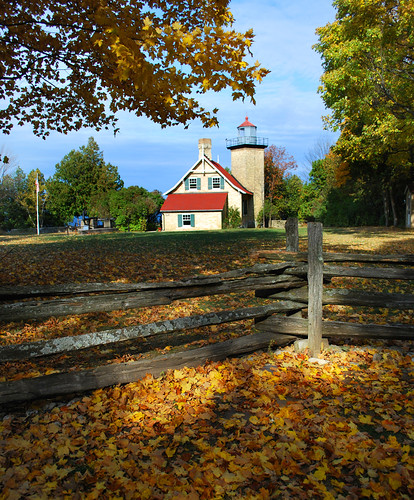
The above photograph of the Eagle Bluff Lighthouse in Door County, Wisconsin is a bit too typical of a "postcard" shot, but it was begging to be taken. Mid-morning on a fall day when the colors had reached their peak. Sun illuminating the lighthouse through a clearing in the surrounding trees. Blue sky creating a contrast of color to the gold and orange leaves. A spot of sunlight hitting the juncture of the split rail fence. I was there with a camera. What else could I do?

Photograph © 2008 James Jordan.

Labels: , ,

Tuesday, June 12, 2007

The twilight zone

Just because the sun’s gone down doesn’t necessarily mean it’s time to put the camera away. Some of the most remarkable shots you’ll ever take will be captured in the fading light of day. The above shot of the Wind Point Lighthouse near Racine, Wisconsin and the planet Venus was taken about 45 minutes after sunset. The small beach shot was taken about a half hour after sunset.

Here are a few things to keep in mind should you decide to catch the last light of the day:

The sky slowly takes on a deeper blue cast as night approaches. From about 20 to 40 minutes past sunset is the ideal time to catch the deep indigo color of the sky.

You’ll need a tripod or some other device to keep the camera stock-still during the exposure, which will be quite long.

The rule of thumb I use in positioning the camera – set up low. I usually stay within 14 inches of the ground when shooting night and twilight scenes. The low angle adds to the drama.

If you have a camera with manual settings, I use a one-second exposure at f5.6 using 100 ISO. If you’re using a digital point and shoot, set the exposure to about -1.5 to -2. Autoexposure will want to lighten the photo. Don’t let it.

Embrace the blur. If you can, stop down your lens and increase exposure time. Moving clouds will be rendered as streaks of light in the sky. Waves on the beach will become a ghostly mist.

It takes a fair bit of experimenting to become adept at twilight shooting and many mistakes will be made. But learn from them and over time, catching low-light photos will become second nature.

Labels: ,

Wednesday, June 6, 2007

Be there

Woody Allen once said that “80 percent of being a success is just showing up.” I’m finding that to be the case with my photography. For some crazy reason, I don’t get any good shots when I’m sitting at home with my camera packed in its case. But the odds increase dramatically when I’m out and about with a camera in my hands.

Want to take better pictures? Take pictures. Lots of them. And to stack the deck even more in your favor, follow these hints:

Shoot within a half hour either side of sunrise or sunset. The light is low, warm and soft. Pro photographers don’t call these times the “magic hours” for nothing.

Look for drama. Creatures (human or otherwise) interacting with each other or their environment. Stormy weather. Moving water.

Can’t find drama? Create it. Change your point of view. Shoot from ground level. Find a high place. Tilt the camera. Overexpose. Underexpose. Get closer to your subject. Move farther away.

Compose yourself. Well, actually, compose your pictures. Rule of thirds is a good place to start. I personally try to place my subjects in the vicinity of either of the diagonal lines than run from the top left to lower right corners of the frame and vice versa. But don’t forget to try to go symmetrical every so often. Mix it up.

Build depth. Use diagonal lines in your photos to draw in your viewers. Try to establish three zones – foreground, middle ground and background.

Look for contrasts. Big and small. Near and far. High and low. Colorful and drab.

Then try to do as many of these in one shot as possible.

After you’re done shooting, evaluate what you’ve shot. What worked? What didn’t work? What would you have done differently?

Then go out and “be there” again.

Let me know how it goes.

Photographs © James Jordan.

Labels: ,

Sunday, January 21, 2007

A word about Digital Zoom

For those of you who own a digital point-and-shoot camera: Digital zoom is a marketing gimmick and nothing remotely useful for photographic purposes. Do. Not. Ever. Use. It.

Stick with optical zoom. Optical zoom records everything that can be captured by the lens itself. Once you go beyond the optical range into digital zoom, the camera begins to split pixels in an effort to digitally enlarge the largest image afforded by the lens. The farther you go into the digital zoom range, the lower the quality of the image.

If you’re trying to capture a picture of Bigfoot, the Loch Ness monster, a flying saucer or Elvis, I can perhaps see a use for digital zoom. Otherwise, stick to digital zoom.

You'll thank me later. That is, unless you run into Bigfoot, the Loch Ness monster, a flying saucer or Elvis.

Labels: ,

Thursday, January 18, 2007

7 ways to improve your pictures!

Pro photographer Bruce Giffen offers seven pointers for improving the pictures you take. And in true Ready, Aim, Click fashion, these suggestions work no matter what type of camera you own:

1. Use a tripod for every picture for a year! (I’ll explain in a future post why shooting from a tripod is a must-do for every, and I mean EVERY photographer!)

2. TURN OFF THE ON-CAMERA FLASH, especially with digital cameras. It ruins the mood of most pictures. The exception would be the occasional fill flash image outdoors.

3. Break the rules! All of them. Forget the “Rule of Thirds”! Stop centering every picture. Slant the horizons. Distort with a wide angle lens. Shake the camera! Experiment!

4. Stop using gimmicks. Simple, straight photographs don’t need any gimmicks!

5. Break Rule 4!

6. Other peoples’ opinions of your work are not valid. Yes, a comment about a technical item may be appropriate, but YOUR composition isn’t negotiable! They are only telling you how THEY would have taken the photo if they were there, which they weren’t. Trust your own heart … Remember - Picasso would probably have flunked art class!

7. You can just document a subject or you can attempt to photograph the way it makes you feel. Take for example the Eiffel Tower. I doubt that there are any ways left to document it. But there are millions of ways to express the way it makes one feel. Go with your heart! Always!

Labels:

Tuesday, January 16, 2007

Murphy must have been a photographer!

Some of Murphy’s laws pertaining to photography. I’ve experienced many of these myself!

Automatic cameras aren't

Auto focus won't

If it's stupid but it works, it isn't stupid

Success occurs when no one is looking, failure occurs when everyone is watching

The one item (batteries, film, etc.) you need is always in short supply

Interchangeable parts aren't

Long life batteries only last for a couple of rolls

Weather never cooperates

Everything always works in your home, everything always fails on location

For every action, there is an equal and opposite criticism

There is always a way, and it usually doesn't work

Stunning nature shots invariably happen on two occasions: 1)When animals or the weather are ready. 2) When you're not.

Same rule just substitute children

The important things are always simple

The simple things are always hard

A clean (and dry) camera is a magnet for dust, mud and moisture

Photo experience is something you never get until just after you need it

Lenses are attracted back to their source - hard rocks. Corollary: The more expensive the lens, the greater the attraction.

The greater a photographer's excitement, the greater the chance of fogging film, scratching prints, and deleting files.

As posted in the forums at fredmiranda.com. Hat tip to Denver Photo on Flickr.

Labels: ,

Sunday, January 7, 2007

Rule of thumb: Red rule

I learned the Red Rule from a newspaper photographer. He simply told me, "If you see red, shoot it!" Since then, I've taken note of all the red that shows up in photos that appear in newspapers and news magazines. There's even a group at Flickr dedicated to following the Red Rule, to which I've submitted a few scarlet scatterings of my own.

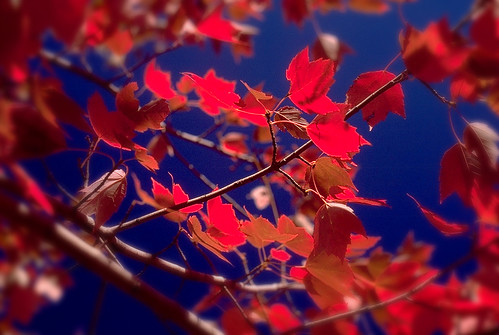
Red commands attention. These photos show a frame full of red and just a spot of red in a scene, and that both can be effective in drawing attention. So get out there and shoot some pictures that will have your viewers seeing red.

Photographs © 2007 James Jordan. Click on pictures to enlarge.

Labels: ,